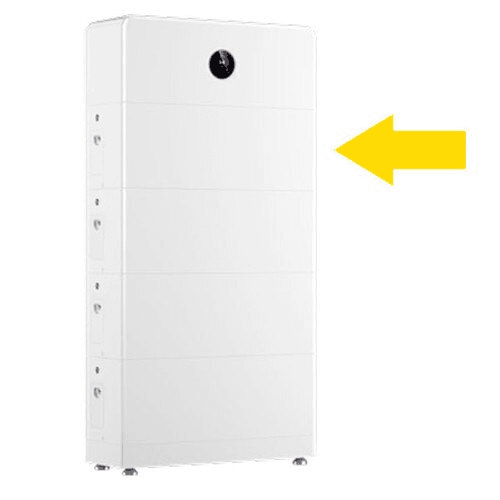
Information about 8.3 kWh Battery Module for GoodWe ESA 3-10K Inverters
The GoodWe GW8.3-BAT-D-G20 battery module is a high-voltage energy storage solution designed for GoodWe ESA systems. It offers a nominal capacity of 8.32 kWh and 8.0 kWh of usable energy, uses LFP (LiFePO4) battery technology, and provides up to 8 kW of maximum charge and discharge power, allowing you to store surplus energy from a photovoltaic installation and use it later to increase self-consumption.
This module is specially designed to integrate with GoodWe ESA 3-10K hybrid systems. Its modular design allows the storage capacity of the installation to be progressively expanded, while the IP66 protection rating, integrated heating, and aerosol fire suppression system provide safety and versatility for residential installations.
8.32 kWh nominal capacity and 8 kWh usable
The GoodWe GW8.3-BAT-D-G20 offers 8.32 kWh of nominal energy and a designed usable energy of 8.0 kWh. This capacity makes it possible to store a significant portion of the surplus generated by a residential photovoltaic installation for use when solar production drops or during nighttime hours.
- Nominal energy: 8.32 kWh.
- Usable energy: 8.0 kWh.
- Chemistry: LFP (LiFePO4).
- Application: residential energy storage.
GoodWe determines usable energy under specific test conditions at the beginning of the battery life. The energy actually available may vary depending on charge and discharge power, temperature, state of charge, and operating conditions.
LFP LiFePO4 technology
The battery uses lithium iron phosphate or LiFePO4 cells, a chemistry widely used in stationary storage systems for its thermal stability, long service life, and suitable performance in applications with frequent charge and discharge cycles.
GoodWe states a service life of 8,000 cycles or more for the GW8.3-BAT-D-G20 under the specific laboratory conditions defined by the manufacturer.
Up to 8 kW charge and discharge
The module is designed to provide high energy exchange power with the ESA system. For the GW8.3-BAT-D-G20, GoodWe specifies a maximum input power of 8 kW and a maximum output power of 8 kW.
- Maximum system charge power: 8 kW.
- Maximum system discharge power: 8 kW.
- Maximum peak output power: 12 kW for 10 seconds.
- Maximum input current: 19 A.
- Maximum output current: 21 A.
Available power may be reduced depending on temperature and battery state of charge.
High-voltage battery for GoodWe ESA
In single-phase GoodWe ESA systems, the module operates within an operating range of 350 to 550 V. This high-voltage operation allows direct integration into the storage architecture of compatible ESA series hybrid inverters.
- Voltage range in single-phase system: 350-550 V.
- Communication: CAN.
- Compatibility: compatible GoodWe ESA storage systems.
Modular and expandable system
One of the main advantages of the GW8.3-BAT-D-G20 is its scalable design. GoodWe allows systems with multiple modules to be configured to adapt the total storage capacity to the needs of each home or installation.
The current documentation for the ESA series establishes a scalability of up to 12 modules. In stacked installations in a single column, the manufacturer limits the maximum number of connected units in parallel in that arrangement to 6 modules.
As a reference, the nominal capacity increases as follows when using GW8.3-BAT-D-G20 modules:
- 1 module: 8.32 kWh.
- 2 modules: 16.64 kWh.
- 3 modules: 24.96 kWh.
- 4 modules: 33.28 kWh.
- 5 modules: 41.60 kWh.
- 6 modules: 49.92 kWh.
The final number of admissible modules should always be checked with the inverter, architecture, and specific version of the installed GoodWe system.
IP66 protection
The module has an IP66 protection rating, providing a high level of protection against dust and water ingress. This expands the installation possibilities of the system, always respecting the location, ventilation, and mounting conditions specified by GoodWe.
The manufacturer also highlights the thermal and electrical separation applied in the range architecture as part of its design aimed at improving system safety and reliability.
Integrated aerosol fire suppression system
The GW8.3-BAT-D-G20 includes an integrated aerosol fire suppression system as standard. This solution is designed to provide an additional active fire control function within the storage module.
GoodWe integrates this function together with other protection measures inherent to the Lynx D G2 technology used as the basis for these ESA series modules.
Integrated heating for low temperatures
The module incorporates an integrated heating system, extending the conditions under which the battery can be charged. GoodWe states charging operation from -18 °C to +55 °C.
- Charging temperature: -18 °C to +55 °C.
- Discharging temperature: -20 °C to +55 °C.
- Heating: integrated.
This feature is especially useful in installations located in areas where ambient temperature can drop significantly during winter.
CAN communication
Communication between the battery and the energy management system is carried out via CAN. This interface makes it possible to exchange the information needed to manage charging, discharging, operating status, and protection of the storage system.
The electronic coordination between battery and inverter allows the system operation to be automatically adapted to the actual battery conditions and the installation’s energy needs.
Quiet operation
GoodWe states a sound emission of 29 dB or less for this module, making it suitable for residential installations where noise level can be an important factor.
Wall-mounted or floor-stacked installation
The GW8.3-BAT-D-G20 offers different mounting options to suit the available space. It can be installed stacked on the floor or wall-mounted following the instructions and using the corresponding accessories indicated by GoodWe.
Its dimensions are common to the modules in this family, making it easier to create visually integrated modular systems.
- Width: 800 mm.
- Height: 326 mm.
- Depth: 270 mm.
- Weight: 79 ±1 kg.
- Mounting: floor-stacked or wall-mounted.
Operating environmental conditions
The module is designed to operate in a wide range of environmental conditions:
- Charging temperature: -18 °C to +55 °C.
- Discharging temperature: -20 °C to +55 °C.
- Permissible relative humidity: 4-100 %.
- Maximum operating altitude: 4,000 m.
- Noise: ≤29 dB.
Module storage
GoodWe also sets limits for storage time when the battery remains unused:
- Up to 12 months: between -20 °C and +35 °C.
- Up to 6 months: between +35 °C and +45 °C.
To properly maintain the battery during long periods out of service, the storage, maintenance, and state-of-charge instructions indicated in the official manual must be followed.
Standards and certifications
The GW8.3-BAT-D-G20 has been developed in accordance with different international standards applicable to energy storage systems and lithium batteries.
- IEC 62619.
- IEC 60730.
- EN 62477.
- IEC 63056.
- IEC 62040.
- CE.
- CEC.
- VDE 2510.
- UN38.3 for transport.
- ADR.
Technical features of the GoodWe GW8.3-BAT-D-G20
- Brand: GoodWe.
- Model: GW8.3-BAT-D-G20.
- Type: high-voltage battery module.
- Technology: LFP (LiFePO4).
- Nominal energy: 8.32 kWh.
- Usable energy: 8.0 kWh.
- Voltage range in single-phase system: 350-550 V.
- Maximum input current: 19 A.
- Maximum output current: 21 A.
- Maximum input power: 8 kW.
- Maximum output power: 8 kW.
- Maximum peak power: 12 kW for 10 seconds.
- Communication: CAN.
- Service life: ≥8,000 cycles under manufacturer test conditions.
- Scalability: up to 12 modules depending on configuration.
- Maximum in a stacked column: 6 modules.
- Heating: integrated.
- Fire suppression system: integrated aerosol.
- Protection rating: IP66.
- Charging temperature: -18 °C to +55 °C.
- Discharging temperature: -20 °C to +55 °C.
- Maximum altitude: 4,000 m.
- Noise level: ≤29 dB.
- Dimensions (W x H x D): 800 x 326 x 270 mm.
- Weight: 79 ±1 kg.
- Mounting: floor or wall.
Modular storage for GoodWe ESA systems
The GoodWe GW8.3-BAT-D-G20 8.3 kWh is a storage solution specially designed to expand the self-consumption capabilities of GoodWe ESA hybrid systems. Its 8 kWh of usable energy, LFP technology, continuous power of up to 8 kW, 12 kW peak power, and IP66 protection make it possible to configure high-performance residential installations.
Its modular architecture makes it possible to increase storage capacity as the installation’s energy needs grow, while the integrated heating, aerosol fire suppression, CAN communication, and declared service life of at least 8,000 cycles complete a solution designed to offer safety, flexibility, and high storage capacity.
Important: the maximum number of modules, available power, and final system configuration must be verified according to the GoodWe ESA inverter model used, the installation architecture, and the manufacturer’s current compatibility list.
