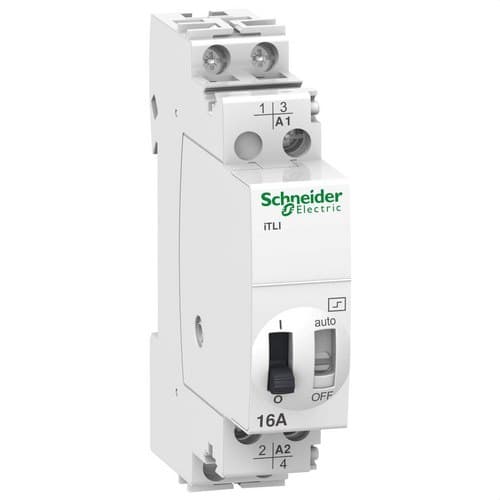
Information about ITLI Remote Control Switch 1P 16A 230V AC 110V DC
The Schneider Electric Acti9 iTLI A9C30815 impulse relay is a modular 16 A impulse relay, primarily designed for controlling lighting circuits from one or more pushbuttons. It features 2 poles with 1 normally open contact and 1 normally closed contact, and a control coil compatible with 230-240 V AC at 50/60 Hz or 110 V DC. Its impulse operation changes the state of the contacts each time it receives a short command, making it easy to control the same load from different points.
It is part of Schneider Electric’s Acti9 iTL range and has a compact 18 mm single-module format for DIN rail mounting. Its high electrical durability, up to 200,000 cycles in AC-21 category, makes it suitable for residential, commercial, and professional electrical panels where frequent control of lighting or other compatible loads is required.
Main features of the Schneider Electric A9C30815
- Brand: Schneider Electric.
- Range: Acti9.
- Family: iTL.
- Model: iTLI.
- Reference: A9C30815.
- Type: impulse relay / modular impulse relay.
- Rated current: 16 A.
- Number of poles: 2P.
- Contacts: 1 NO + 1 NC.
- Control voltage: 230-240 V AC or 110 V DC.
- AC control frequency: 50/60 Hz.
- Power circuit operating voltage: 24 to 250 V AC.
- Control pulse duration: 50 ms to 1 s.
- Maximum switching frequency: 5 operations per minute.
- Recommended maximum: 100 operations per day.
- Mounting: DIN rail.
- Width: 18 mm.
- Height: 84 mm.
- Depth: 60 mm.
- Weight: approximately 112 g.
- Protection rating: IP20.
- Protection in suitable enclosure: up to IP40.
16 A impulse relay for pushbutton control
The A9C30815 allows a load to be controlled by electrical impulses sent from one or more pushbuttons. Each impulse changes the internal mechanism state, alternating the contact position.
This operating principle is especially practical in installations where the same lighting needs to be switched on and off from multiple points, avoiding more complex wiring solutions based solely on traditional switches.
1 NO contact + 1 NC contact
The iTLI A9C30815 has one normally open (NO) contact and one normally closed (NC) contact.
This configuration provides two complementary states at the same time, expanding the control possibilities compared with a basic impulse relay with only one normally open contact.
2-pole configuration
Schneider Electric identifies this reference as a 2P device. Therefore, it does not correspond to the single-pole version indicated in the provided title.
The configuration integrates the 1 NO + 1 NC contacts within the impulse relay itself, providing a compact modular control solution.
230-240 V AC or 110 V DC coil
The control coil supports:
- 230-240 V AC at 50/60 Hz.
- 110 V DC.
This dual supply option allows the impulse relay to be used in different control circuits, always respecting the voltages specified by Schneider Electric.
Control pulse from 50 ms to 1 second
The A9C30815 is designed to receive short-duration commands. Schneider Electric specifies a pulse duration between 50 milliseconds and 1 second.
This operation allows conventional momentary pushbuttons to be used to change the circuit state without needing to keep the control command continuously energized.
Up to 5 operations per minute
The maximum frequency specified by Schneider Electric is 5 switching operations per minute, with a recommended maximum of 100 operations per day.
These values should be respected especially in automated applications where the impulse relay may receive frequent commands.
Rated current of 16 A
The impulse relay has a rated current of 16 A. The actual switching capacity also depends on the nature of the load and its utilization category.
For lighting circuits with electronic loads, LED lighting, or high inrush currents, the load compatibility and Schneider Electric utilization tables should always be checked.
Operating voltage from 24 to 250 V AC
The power circuit is designed to operate with an operating voltage between 24 and 250 V AC.
The rated insulation voltage Ui is 440 V AC, while the impulse withstand voltage Uimp reaches 6 kV.
Overvoltage category IV
Schneider Electric classifies the device with overvoltage category IV and pollution degree 3, characteristics that define its dielectric performance within the intended installation environment.
High electrical durability
The Acti9 iTLI is designed to withstand a high number of electrical operations:
- AC-21: up to 200,000 cycles.
- AC-22: up to 100,000 cycles.
This durability makes it suitable for installations where the lighting circuit is used and switched frequently.
DIN rail mounting
The impulse relay is installed directly by clip-on mounting on a DIN rail, making it easy to integrate into modular electrical panels alongside miniature circuit breakers, residual current devices, contactors, and other Acti9 devices.
Its width of only 18 mm corresponds to a standard module, helping reduce the space required inside the panel.
Compact dimensions
- Width: 18 mm.
- Height: 84 mm.
- Depth: 60 mm.
- Weight: approximately 112 g.
IP20 protection
The device offers an IP20 protection rating once installed under the manufacturer’s intended conditions.
When mounted inside a suitable enclosure, the assembly can achieve front protection of up to IP40, depending on the panel used and its configuration.
Operating temperatures
Schneider Electric specifies a wide environmental range:
- Operating temperature: -20 to +50 °C.
- Storage temperature: -40 to +70 °C.
Applications of the Schneider Electric A9C30815
The impulse relay can be used mainly in circuits where a load needs to be controlled from multiple pushbuttons:
- Corridor lighting.
- Staircases.
- Common areas.
- Garages.
- Homes.
- Commercial buildings.
- Offices.
- Retail premises.
- Installations with multiple control points.
- Simple automation panels.
Impulse relay operation
Unlike a conventional contactor, the impulse relay does not need its coil to remain permanently energized to keep the contacts in position. A brief impulse changes the mechanism state, which remains in that state until a new command is received.
This operation is especially suitable for lighting installations with multiple pushbuttons distributed across different areas.
Applicable standards
The Schneider Electric A9C30815 complies with the following standards:
- IEC/EN 60669-1.
- IEC/EN 60669-2-2.
Technical data for the Schneider Electric A9C30815
- Manufacturer: Schneider Electric.
- Reference: A9C30815.
- Range: Acti9.
- Product: iTL.
- Model: iTLI.
- Type: impulse relay / impulse relay.
- Number of poles: 2P.
- Contacts: 1 NO + 1 NC.
- Rated current: 16 A.
- Power circuit voltage: 24-250 V AC.
- Control voltage: 230-240 V AC / 110 V DC.
- Frequency: 50/60 Hz.
- Command duration: 50 ms-1 s.
- Maximum frequency: 5 operations/minute.
- Recommended maximum: 100 operations/day.
- Electrical durability AC-21: 200,000 cycles.
- Electrical durability AC-22: 100,000 cycles.
- Ui: 440 V AC.
- Uimp: 6 kV.
- Overvoltage category: IV.
- Pollution degree: 3.
- Mounting: DIN rail.
- Width: 18 mm.
- Height: 84 mm.
- Depth: 60 mm.
- Weight: approximately 112 g.
- Protection: IP20.
- Protection in enclosure: up to IP40.
- Operating temperature: -20 to +50 °C.
- Storage temperature: -40 to +70 °C.
- Standards: IEC/EN 60669-1 and IEC/EN 60669-2-2.
Acti9 iTLI modular impulse relay for lighting control
The Schneider Electric A9C30815 combines a 16 A rated current, 1 NO + 1 NC contacts, and a coil compatible with 230-240 V AC or 110 V DC in a DIN format only 18 mm wide. Its impulse operation makes it easy to control the same load from multiple pushbuttons and reduces wiring complexity in lighting installations.
With up to 200,000 electrical cycles in AC-21, 440 V insulation, 6 kV impulse withstand, and modular DIN rail mounting, it is a compact solution for residential and commercial panels requiring centralized or multi-point pushbutton control.
