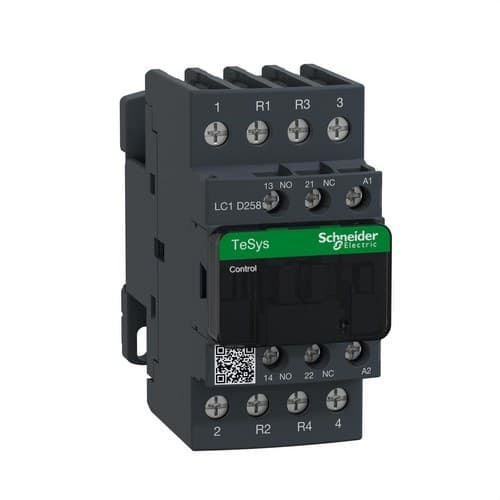
Information about Contactor 40A 1 NO/1 NC 48V 50-60HZ 2P
The Schneider Electric LC1D258E7 contactor from the TeSys D / TeSys Deca range is an electromechanical contactor with 4 poles, designed mainly for switching resistive loads in AC-1 utilization category. It features 2 normally open main contacts (2 NO) and 2 normally closed main contacts (2 NC), supports a rated operational current of 40 A up to 440 V AC in AC-1, and is equipped with a 48 V AC 50/60 Hz control coil.
In addition to the four main power contacts, it includes 2 built-in auxiliary contacts, 1 NO + 1 NC, which can be used for signaling, interlocking, or feedback functions within the control circuit. Its compact 45 mm width, screw terminals, and the option of DIN rail mounting or screw fixing on a plate make it easy to integrate into industrial, commercial, and automation electrical panels.
4-pole contactor with 2 NO + 2 NC
The LC1D258E7 reference uses a 4-pole power configuration. Its composition is:
- 2 normally open main contacts (NO).
- 2 normally closed main contacts (NC).
This arrangement allows several conductors or circuits to be controlled simultaneously and is especially suitable for certain resistive load switching applications.
It is important not to confuse these four main poles with the built-in auxiliary contacts. The 1 NO + 1 NC designation refers exclusively to the auxiliary signaling and control contacts.
40 A in AC-1 utilization category
Schneider Electric specifies for this contactor a rated operational current Ie of 40 A at temperatures up to 60 °C and voltages up to 440 V AC in AC-1 category.
AC-1 category is mainly intended for non-inductive or slightly inductive loads, such as certain resistive heating systems, heating elements, and other loads with a high power factor.
- Rated operational current: 40 A.
- Main application category: AC-1.
- Reference voltage for 40 A: up to 440 V AC.
- Conventional thermal current of the power circuit: 40 A at 60 °C.
48 V AC 50/60 Hz control coil
The E7 suffix in the reference identifies a 48 V AC control coil compatible with 50 and 60 Hz networks. This voltage must match the control circuit voltage available in the installation.
- Coil voltage: 48 V AC.
- Frequency: 50/60 Hz.
- Control circuit type: alternating current.
The coil enables the contactor to be electromagnetically actuated, changing the state of its main and auxiliary contacts simultaneously.
Integrated 1 NO + 1 NC auxiliary contacts
The LC1D258E7 includes as standard:
- 1 normally open auxiliary contact.
- 1 normally closed auxiliary contact.
These contacts can be used in control circuits for status indication, electrical interlocking, self-holding, or other auxiliary functions.
The NC auxiliary contact has certified mirror contact function under the conditions specified by Schneider Electric.
Operational voltage up to 690 V AC
The contactor main circuit is designed to operate at high voltages within its rated operating conditions. Schneider Electric specifies:
- Rated operational voltage of the power circuit: up to 690 V AC.
- Power circuit frequency: 25 to 400 Hz.
- DC operational voltage: up to 300 V DC.
- Rated impulse withstand voltage Uimp: 6 kV.
- Overvoltage category: III.
The 40 A rating indicated for this reference applies specifically to AC-1 use up to 440 V AC and should not be automatically extrapolated to other utilization categories.
High making and breaking capacity
For the main circuit, Schneider Electric specifies the following electromechanical characteristics:
- Rated making capacity: 450 A at 440 V AC.
- Rated breaking capacity: 450 A at 440 V AC.
- Permissible short-time current for 1 second: 380 A at 40 °C.
- Permissible short-time current for 10 seconds: 240 A at 40 °C.
- Permissible short-time current for 1 minute: 120 A at 40 °C.
- Permissible short-time current for 10 minutes: 50 A at 40 °C.
Up to 3,600 operations per hour
The TeSys design is suitable for automation applications requiring a high switching frequency. Schneider Electric specifies for this reference a maximum operating frequency of up to 3,600 cycles per hour within the conditions indicated by the manufacturer.
This capability makes it suitable for automatic systems where loads must be switched on and off frequently, while respecting the utilization category and the corresponding electrical limits.
DIN rail or panel mounting
The contactor offers two main installation options:
- DIN rail mounting.
- Screw fixing on a plate.
This versatility makes it easy to integrate into modular electrical panels as well as industrial automation and control cabinets.
Compact 45 mm width
One of the advantages of the TeSys D / Deca range is its compact design. The LC1D258E7 occupies only 45 mm in width, allowing several contactors and auxiliary devices to be installed in a reduced space.
- Width: 45 mm.
- Approximate height: 91 mm.
- Approximate depth: 99 mm.
- Approximate weight: 0.47 kg.
Screw terminal connection
The LC1D258E7 reference uses screw clamp terminals to provide a mechanically secure connection and to simplify maintenance and replacement of the contactor.
The multi-standard screws used in the TeSys Deca range are designed to facilitate professional installation and provide a secure connection for conductors within the cross-sections accepted by the manufacturer.
Applications of the Schneider Electric LC1D258E7
Due to its four-pole configuration and AC-1 utilization category, this contactor is especially suitable for switching resistive loads and automation circuits.
- Electrical heating systems.
- Heating resistor banks.
- HVAC equipment with compatible loads.
- Automation electrical panels.
- Resistive load control.
- Industrial switching systems.
- Commercial building installations.
- Applications requiring 2 NO + 2 NC main contacts.
Integration in TeSys control systems
Schneider Electric’s TeSys range is designed as a modular control and protection platform. The LC1D258E7 can be integrated with compatible accessories and auxiliary elements to expand the signaling, control, and interlocking functions of the assembly.
The integrated auxiliary contacts also reduce the need to install additional auxiliary blocks in simple applications that only require one NO signal and one NC signal.
Operating conditions
The contactor is designed to provide reliable operation in professional electrical panels and industrial environments. Schneider Electric specifies operation in environments up to 60 °C to maintain the indicated AC-1 current of 40 A.
Installation must be carried out in accordance with the ventilation, spacing, mounting, and derating conditions indicated by the manufacturer when ambient conditions differ from the rated ones.
Technical characteristics of the Schneider Electric LC1D258E7
- Brand: Schneider Electric.
- Reference: LC1D258E7.
- Range: TeSys D / TeSys Deca.
- Short name: LC1D.
- Type: electromechanical contactor.
- Main application: resistive loads.
- Main utilization category: AC-1.
- Number of main poles: 4.
- Main contact configuration: 2 NO + 2 NC.
- Rated operational current: 40 A up to 440 V AC in AC-1.
- Conventional thermal current of the power circuit: 40 A at 60 °C.
- Rated operational voltage AC: up to 690 V AC.
- Power circuit frequency: 25-400 Hz.
- Rated operational voltage DC: up to 300 V DC.
- Coil: 48 V AC.
- Coil frequency: 50/60 Hz.
- Integrated auxiliary contacts: 1 NO + 1 NC.
- Auxiliary circuit thermal current: 10 A at 60 °C.
- Rated impulse withstand voltage Uimp: 6 kV.
- Overvoltage category: III.
- Main circuit making capacity: 450 A at 440 V.
- Main circuit breaking capacity: 450 A at 440 V.
- Maximum switching frequency: up to 3,600 cycles/h.
- Mounting: DIN rail or screw fixing.
- Terminal type: screw terminals.
- Width: 45 mm.
- Approximate height: 91 mm.
- Approximate depth: 99 mm.
- Approximate weight: 0.47 kg.
- Main standards: IEC/EN 60947-4-1 and IEC/EN 60947-5-1.
- EAN: 3389110250374.
Four-pole contactor for resistive loads up to 40 A
The Schneider Electric LC1D258E7 offers a compact solution for switching resistive loads up to 40 A in AC-1. Its 4 main poles in a 2 NO + 2 NC configuration make it possible to implement switching schemes that require both open and closed contacts simultaneously.
The 48 V AC 50/60 Hz coil, the built-in 1 NO + 1 NC auxiliaries, screw terminals, and the option of mounting on a DIN rail or panel make it easy to incorporate into automation electrical panels, HVAC installations, and professional control systems.
