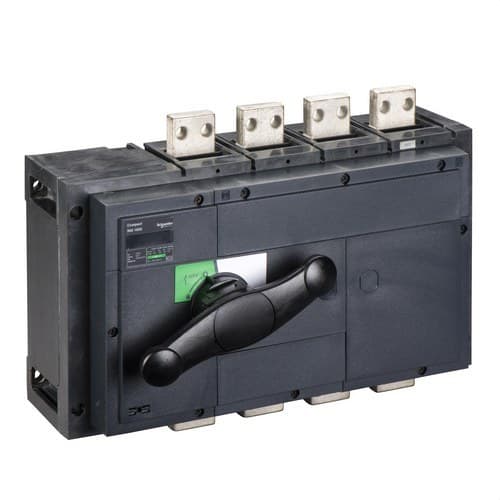
Information about Interpact INS1600 4P 1600 A Disconnect Switch
The Schneider Electric ComPacT INS1600 31337 switch disconnector is a high-current switching and isolation device with 4 poles and a conventional thermal current rating of Ith 1600 A at 60 °C. It is designed for switching and disconnection of low-voltage distribution circuits, with a rated operational voltage of up to 690 V AC at 50/60 Hz or 250 V DC, a black front rotary handle, and positive contact position indication.
The 31337 reference, historically sold as Interpact INS1600 and now integrated into the ComPacT INS range, is especially suitable for high-power switchboards, main low-voltage panels, industrial distribution, and installations where a reliable isolation and disconnection point is required for high currents.
This is a non-automatic switch disconnector: its main function is to make, carry, and break current and provide electrical isolation, but it does not include its own thermal or magnetic protection against overloads and short circuits. For this reason, it must be coordinated with the appropriate protection devices in the installation.
4-pole, 1600 A switch disconnector
The ComPacT INS1600 features 4 poles and a conventional free-air thermal current of 1600 A at 60 °C. Its design allows simultaneous opening and closing of all four poles, making it suitable for four-pole distribution installations.
- Brand: Schneider Electric.
- Range: ComPacT.
- Series: ComPacT INS / Interpact INS.
- Model: INS1600.
- Reference: 31337.
- Type: non-automatic switch disconnector.
- Number of poles: 4P.
- Conventional thermal current Ith: 1600 A at 60 °C.
- Network type: AC and DC.
- Frequency: 50/60 Hz.
Operational voltage up to 690 V AC
The Schneider Electric 31337 is designed to operate in low-voltage AC and DC networks within the limits specified by the manufacturer.
- Maximum rated operational voltage Ue in AC: 690 V AC.
- Frequency: 50/60 Hz.
- Maximum rated operational voltage in DC: 250 V DC with the 4 poles connected in series.
- Rated insulation voltage Ui: 1000 V AC.
- Rated impulse withstand voltage Uimp: 12 kV.
These characteristics make it suitable as an incoming and isolation device in high-power electrical switchboards.
Operational currents by utilization category
The permissible service current depends on the utilization category and operating voltage. Although the device has a conventional thermal current of 1600 A, the operational currents during switching may be lower in certain categories.
Among the values specified by Schneider Electric are:
- AC-21B: up to 1600 A between 220/240 and 660/690 V.
- AC-22B: up to 1600 A between 220/240 and 660/690 V.
- AC-21A: 1450 A at 220/240 and 380/415 V; 1250 A at higher voltages.
- AC-22A: 1450 A at 220/240 and 380/415 V; 1250 A at higher voltages.
- AC-23A: 1250 A between 220/240 and 660/690 V.
- DC-21A, DC-22A and DC-23A: up to 1600 A at 250 V DC using the 4 poles in series.
Final selection must be made according to the voltage, utilization category, and load type of the installation.
AC-21, AC-22 and AC-23 categories
The ComPacT INS1600 can be used with different load types according to the categories defined by IEC 60947-3:
- AC-21: switching of resistive loads with moderate overloads.
- AC-22: switching of mixed resistive and inductive loads.
- AC-23: switching of motor loads or other highly inductive loads.
This versatility allows reference 31337 to be used in multiple industrial and power distribution applications.
Up to 710 kW at 380/400 V in AC-23
In inductive load switching applications within AC-23, Schneider Electric specifies high operational power ratings:
- 220/240 V: up to 400 kW.
- 380/400 V: up to 710 kW.
- 415 V: up to 800 kW.
- 500/525 V: up to 900 kW.
These values show the INS1600’s capability for use in high-power industrial installations, always respecting the utilization category and mounting conditions specified by Schneider Electric.
Suitable for isolation
The Schneider Electric ComPacT INS1600 is specifically designed to provide safe electrical isolation. It is suitable for isolation in accordance with IEC 60947-1 and IEC 60947-3 and features positive contact position indication.
- Suitable for isolation: yes.
- Contact position indication: yes.
- Visible break: no.
The positive contact indication makes it possible to reliably know whether the disconnector is open or closed, a particularly important feature during maintenance and lockout procedures.
Black front rotary handle
This version includes a black direct front rotary handle. Schneider Electric designs this operating mechanism to facilitate manual opening and closing operations even on high-current equipment.
- Handle type: direct front rotary.
- Handle color: black.
- Operation: manual.
- Mounting: fixed.
Short-circuit making capacity
The INS1600 offers a high making capacity for short-circuit currents. Schneider Electric specifies a rated short-circuit making capacity Icm of 75 kA at 690 V AC for the disconnector used on its own.
When coordinated with certain upstream circuit breakers, the technical documentation specifies a making capacity that can reach 330 kA at 690 V AC, depending on the protection combination used.
- Icm of the disconnector alone: 75 kA at 690 V AC.
- Icm coordinated with upstream protection: up to 330 kA at 690 V AC depending on the combination.
High short-time withstand current
The Schneider Electric 31337 is designed to withstand significant short-circuit currents for short periods while upstream protection devices operate.
- Icw for 0.5 s: 50 kA.
- Icw for 0.8 s: 42 kA.
- Icw for 1 s: 35 kA.
- Icw for 3 s: 20 kA.
- Icw for 20 s: 10 kA.
- Icw for 30 s: 8 kA.
These values correspond to the conditions defined by IEC 60947-3.
Does not replace a protective circuit breaker
It is important to distinguish the INS1600 from a thermal-magnetic circuit breaker. The 31337 is a non-automatic switch disconnector, so it does not have a trip unit to detect overloads or short circuits.
Circuit protection must be provided by fuses, circuit breakers, or other properly coordinated and sized protection devices according to the characteristics of the installation.
Continuous duty
The device is designed for continuous duty. Schneider Electric also specifies an intermittent duty class of class 120 at 60%.
These characteristics allow it to be integrated into distribution boards that remain energized continuously for long periods.
Fixed mounting and front connections
Reference 31337 corresponds to a fixed mounting version. The upper and lower power connections are made from the front, facilitating integration into distribution boards.
- Mounting type: fixed.
- Support: compatible plate or structure.
- Upper connection: front.
- Lower connection: front.
- Connection pitch: 70 mm.
Format for high-power switchboards
Due to its 1600 A rating, the INS1600 has dimensions suited to high-power distribution applications.
- Width: 410 mm.
- Height: 300 mm.
- Depth: 146.5 mm.
- Net weight: approximately 18 kg.
Mechanical and electrical durability
The ComPacT INS1600 mechanism is designed to provide a long service life in professional applications.
- Mechanical durability: 3,000 cycles.
- Electrical durability AC-21A: 500 cycles.
- Electrical durability AC-22A: 500 cycles.
- Electrical durability AC-23B: 500 cycles.
The specific electrical durability depends on the utilization category, voltage, and switching conditions.
IP40 and IK07 protection
The front of the device has an IP40 protection rating according to IEC 60529 and an IK07 mechanical resistance rating.
- Protection rating: IP40.
- Mechanical protection rating: IK07.
- Pollution degree: 3.
Wide temperature range
The switch disconnector is designed to operate in demanding industrial environments:
- Operating ambient temperature: from -25 °C to +70 °C.
- Storage temperature: from -50 °C to +85 °C.
Front class II insulation
Schneider Electric specifies a front face insulation level of class II for the ComPacT INS1600 in accordance with IEC 60664. This feature is part of the device’s safety design for integration into low-voltage electrical switchboards.
Standards and certifications
Reference 31337 complies with the main international standards applicable to low-voltage switch disconnectors:
- IEC 60947-1.
- IEC 60947-3.
- IEC 60529 for the protection rating.
- KEMA-KEUR certification.
Technical characteristics of Schneider Electric 31337
- Brand: Schneider Electric.
- Range: ComPacT.
- Series: INS / Interpact INS.
- Model: INS1600.
- Reference: 31337.
- Type: non-automatic switch disconnector.
- Number of poles: 4P.
- Conventional thermal current Ith: 1600 A at 60 °C.
- Maximum operational voltage: 690 V AC / 250 V DC.
- Frequency: 50/60 Hz.
- Insulation voltage Ui: 1000 V.
- Rated impulse withstand voltage Uimp: 12 kV.
- Utilization categories: AC-21, AC-22, AC-23, DC-21, DC-22 and DC-23 depending on voltage and configuration.
- AC-23A at 380/415 V: 1250 A.
- AC-21B / AC-22B: up to 1600 A depending on voltage.
- AC-23 power at 380/400 V: up to 710 kW.
- AC-23 power at 415 V: up to 800 kW.
- Icm at 690 V: 75 kA as a standalone disconnector.
- Icm with upstream protection: up to 330 kA depending on coordination.
- Icw: 35 kA for 1 second.
- Suitable for isolation: yes.
- Contact position indicator: yes.
- Visible break: no.
- Operating mechanism: direct front rotary.
- Handle color: black.
- Mounting: fixed.
- Connections: front.
- Connection pitch: 70 mm.
- Duty: continuous.
- Mechanical durability: 3,000 cycles.
- Protection rating: IP40.
- Mechanical resistance: IK07.
- Operating temperature: -25 °C to +70 °C.
- Storage temperature: -50 °C to +85 °C.
- Dimensions: 410 x 300 x 146.5 mm.
- Net weight: approximately 18 kg.
- EAN: 3303430313373.
High-power disconnection for electrical switchboards
The Schneider Electric ComPacT INS1600 31337 is a robust solution for disconnection of high-current circuits in industrial installations and main low-voltage switchboards. Its 4 poles, Ith 1600 A, operational voltage up to 690 V AC, 1000 V insulation, and 12 kV Uimp allow it to be integrated into high-performance distribution systems.
Its high short-circuit withstand capability, black front rotary handle, positive position indication, IP40 protection, and suitability for isolation provide safe and reliable operation in professional installations.
Important: the ComPacT INS1600 is a non-automatic switch disconnector. It does not include its own protection against overloads or short circuits and must be coordinated with fuses, circuit breakers, or other suitable protection devices for the circuit.
